A Bit
About Me
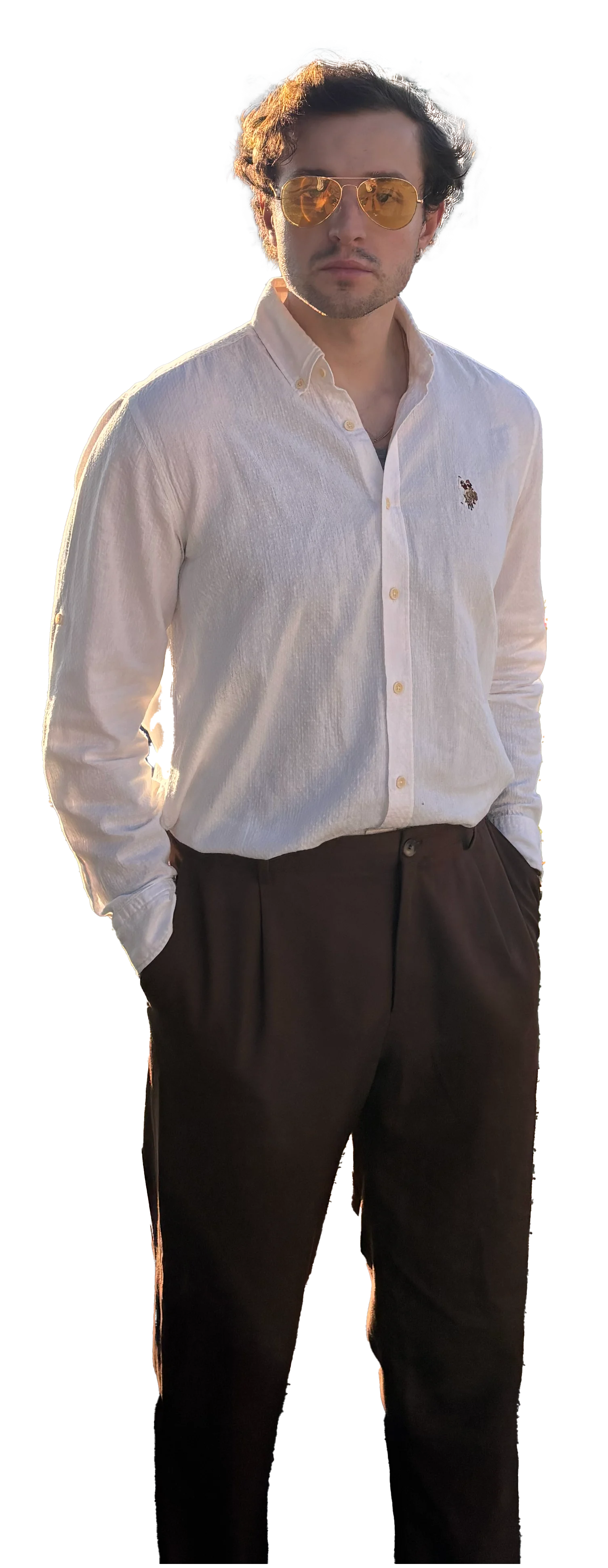
Vi Saint is a Creative Technologist whose work sits between design, engineering & storytelling. Rather than treating these disciplines as separate practices, he combines them into a single process where strategy, visual identity and implementation evolve together.
His background spans branding, UI/UX design, front-end development, motion and interactive experiences. That breadth allows him to move comfortably from early concepts and research to polished, production-ready products, ensuring ideas survive the journey from sketch to screen without losing their intent.
Drawn to ambitious ideas and complex problems
Viktor enjoys transforming technical systems into experiences that feel simple, expressive and memorable. He believes the best digital products are not only functional but emotionally resonant—tools that people understand instinctively and remember long after they’ve left.
Today he works across the full stack — from front-end architecture and back-end systems to brand identity, advertising, graphic design, print production, typography, motion design, video & beyond. Every discipline informs the others & that cross-pollination is what makes the work feel cohesive, considered & alive.
My
Tools
I prefer tools that are open source or built by individuals and small companies. The larger the company, the more exploitative its pricing model and the more the base product gets degraded just to upsell you. Good software lets you do the obvious, steers you toward complex possibilities, and gets out of your way otherwise.
Systems
MacOS
(The Apps Keep Me Bound)
Linux
for the freedom (KDE — Tuxedo OS)
My
Process
where attention is fleeting
but competition fierce
most messages vanish,
before being seen.
Even worse, they fail
to grab your attention
despite making it
in front of your face
But I can break through
with relentless creativity,
wide technical expertise
& unmatched skill diversity
I create meaningful interactions
that remain in customers' heads
using every tool available.
Contact Me
Today
For an Amazing Experience

My
Journey
I grew up obsessed with video games. Not just playing them, but exploring them like secret worlds. I jumped between modern 3D universes and the charming simplicity of 8-bit pixels, trying to understand why each one felt magical in its own way. As a kid, I would dive deep into the history of how games were made, how stories were told through level design & how tiny artistic decisions shaped entire experiences. I loved discovering narrative tricks, strange mechanics & all the odd, clever experiments that never made it into the mainstream. Video games weren't just entertainment for me — they were a limitless playground of ideas. They taught me that technology, art & emotion can combine in completely unexpected ways & I've been chasing that feeling ever since.
My love for books started with a strange pairing: Alice in Wonderland and The Picture of Dorian Gray. One was surreal, whimsical & chaotic; the other was dark, elegant & unnervingly psychological. Together they cracked something open in me. I became obsessed with how stories could twist reality, reveal character, or expose hidden truths. From there I started devouring everything I could get my hands on — reading nearly two books a week — chasing that feeling of slipping into other worlds. Over time my habits expanded into a kind of personal ritual: one fiction book to ignite imagination, one non-fiction to feed curiosity. As my interests grew, the topics exploded outward — philosophy, design, technology, art, psychology, mythology — each one forming a new branch of the inner library I still carry with me.
Technology school was challenging in all the right ways. It pushed me into the deep end of hardware, circuitry, system internals — all the things I quickly realized I didn't actually care about. I respected the complexity, but it didn't spark anything in me. What did spark something was software. The moment I started writing code, the whole world shifted. Software felt alive — expressive, flexible, endlessly creative. I wasn't just plugging components together; I was shaping behavior, building logic, designing experiences. That's where I first understood that my real passion wasn't inside the machine — it was in creating what the machine could do.
University was the place that demanded everything from me. Moving all the way to Slovenia felt like stepping into a bigger version of myself — new people, new ideas & a level of independence I had been craving. I pushed harder than I ever had before, grinding through my first year, proud of every class I passed and every connection I made. It felt like momentum, like the start of something huge. And then the pandemic hit. Overnight, the world shrank. Campus, friends, lectures — all of it collapsed into a single glowing rectangle. I ended up back home, trying to hold onto that drive while everything around me slowed, blurred & broke in ways none of us were prepared for.
The pandemic was dark, horrible & psychologically destructive. Everything I had been building toward suddenly unraveled & I felt stuck in a loop of uncertainty that lasted far longer than I ever expected. But in the middle of all that chaos, I managed to carve out a path forward. I landed a job at Business House — a company in a booming industry of medical supplies and health food — and it became this strange, unexpected lifeline. There I learned how to sell, how to negotiate, how to talk to clients, how to pitch ideas with confidence. I even started traveling for work, discovering a version of myself I didn't know existed. It didn't erase the darkness of that time, but it gave me a direction, a set of skills & a sense of resilience I still carry with me.
University taught me a lot of interesting things, but the class that changed everything was modern web development. It was the first skill that felt both natural and instantly useful — something I was genuinely good at. So I leaned into it. I opened a Fiverr account and started freelancing, building small video games using web technologies. What began as simple experiments quickly grew into full playable ads, interactive experiences & eventually websites. Every project pushed me to learn more, try more, invent more. And honestly, it was amazing — the feeling of turning ideas into something real, something people could actually play with, was like rediscovering the magic of games from my childhood, but this time from the creator's side.
By now I've read so many books, but a few of them rewired me completely. Popism: The Warhol Sixties by Andy Warhol and Pat Hackett, Insanely Great: The Life and Times of Macintosh, the Computer that Changed Everything by Steven Levy & Steve Jobs by Walter Isaacson all hit me at exactly the right moment. From Warhol, I learned how industrialized, repetitive labor can still produce powerful art. From the Macintosh story, I understood how much the details matter — how entire revolutions happen because someone cared enough to polish one more pixel. And from Jobs, I internalized the idea that craftsmanship is emotional, personal & deeply human. Those books taught me to value how something is made far more than how much I make. They shaped my philosophy & gave me the motto I still live and work by: 'Design is how it works!'
Once design clicked for me, I wanted to learn every form of it. I dove into graphic design, teaching myself Photoshop, Illustrator, InDesign & eventually Figma — each one opening a different doorway into how ideas can become visual experiences. I learned to work with video, experimented with visual website builders & kept doubling the set of tools I felt comfortable creating with. Every new skill expanded the way I thought, the way I communicated, the way I solved problems. It felt like assembling a creative toolkit piece by piece, until suddenly I could express almost anything I imagined.
Finally, I shifted my focus back to code. This time, however, I was armed with a deep and practical knowledge of wonderful design principles. I now thrive on the opportunity to blend both crafts—design and development—to build and launch truly amazing products.